
Closer than geostationary orbit
The 2029 passage brings Apophis remarkably close to Earth, giving scientists an unusually detailed look at a large near-Earth asteroid.
COUNTDOWN TO CLOSE APPROACH
FOLLOW APOPHIS TO 2029
Major Apophis news, viewing information and flyby updates — delivered as the 2029 encounter approaches.
Apophis news and viewing updates. Confirm by email. Unsubscribe anytime.Apophis is a near-Earth asteroid roughly 340 meters across. In 2029 it will sweep past Earth at a distance closer than many geostationary satellites — an encounter close enough to transform it into a worldwide observing event while posing no impact threat to Earth in 2029.
2029 CLOSE APPROACH
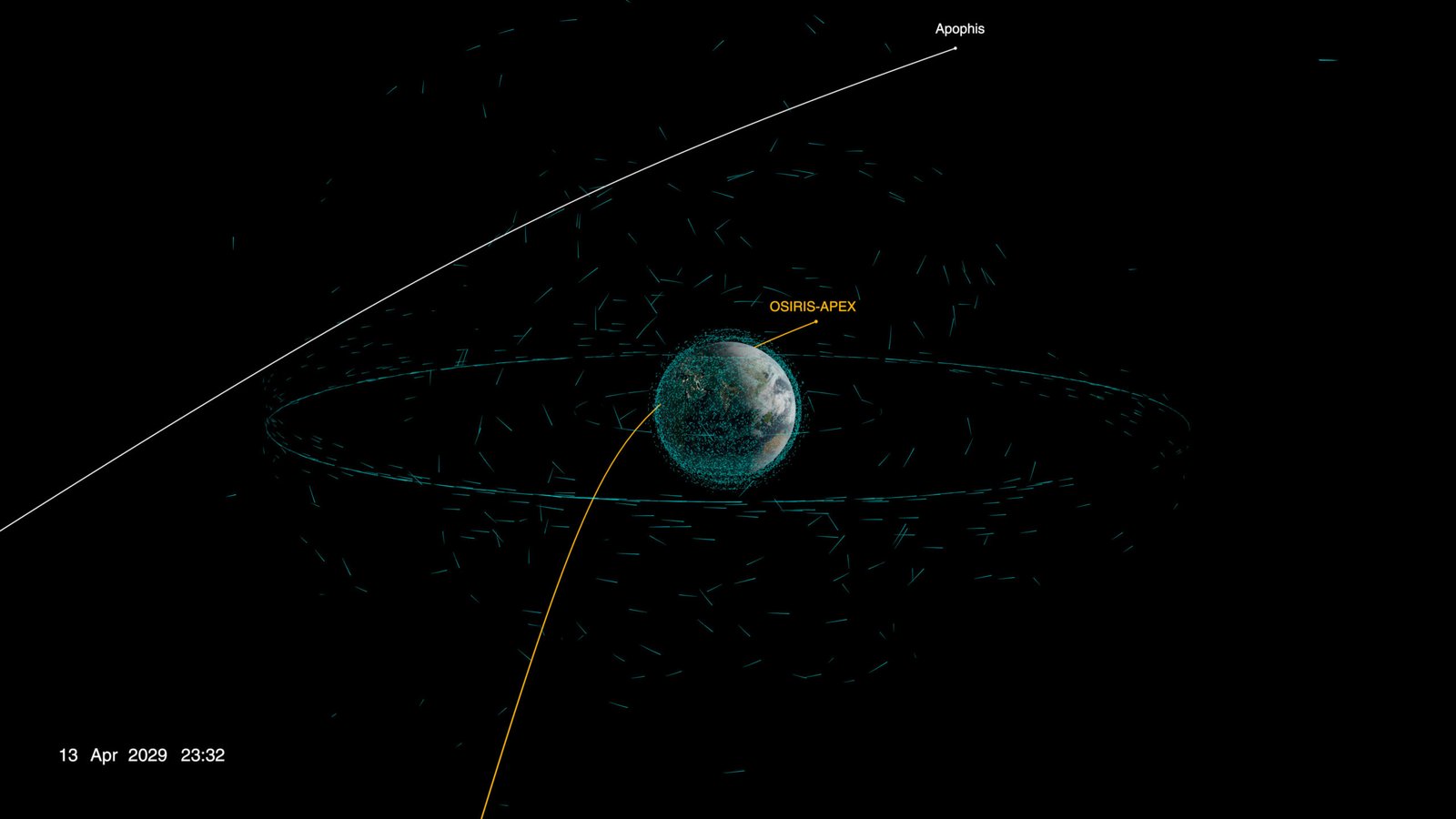
Watch our original 15-second visualization of Apophis approaching Earth and continuing safely into space. The path uses NASA/JPL Horizons positions; Earth and the distance references share one scale. Six hours are compressed into 15 seconds, and the asteroid marker is enlarged for visibility.
NEW CINEMATIC ALTERNATIVE
An artist's impression of Apophis passing safely by Earth in 2029. Scale, surface details and motion are illustrative; the trajectory reference below shows the calculated path.
Visualization by View Apophis · Encounter facts: NASA/JPL ↗.
Visualization by View Apophis · Orbital/close-approach data: NASA/JPL Horizons ↗ · Earth texture: NASA Blue Marble.
Apophis follows the cyan trajectory past the rotating Earth. The dashed ring marks geostationary altitude in the equatorial plane, about 35,786 km above the surface. It is a scale reference, not a prediction of satellite positions or a collision. Earth lighting is approximate; the enlarged asteroid is an artist's marker. Independent artwork by View Apophis; NASA did not create or endorse this animation.
 VIEW LARGER ↗
The 2029 passage brings Apophis remarkably close to Earth, giving scientists an unusually detailed look at a large near-Earth asteroid.
Across favorable regions, observers are expected to have a rare opportunity to see the asteroid move across the night sky without a telescope.
Earth's gravity will measurably alter Apophis. Researchers will study its orbit, rotation and surface before, during and after the encounter.
APRIL 13, 2029
As observing predictions sharpen, we’ll publish location-specific viewing guides, timing, maps and practical advice for watching the flyby.
GET VIEWING UPDATES →